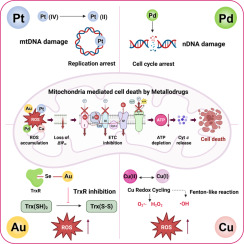
To address the urgent clinical need for more effective and selective cancer treatments, increasing attention has been directed toward metallodrugs that act beyond classical nuclear DNA damage and exploit mitochondrial vulnerabilities in cancer cells. This review critically evaluates recent progress reported from 2020 to 2026 in mitochondria-targeted palladium(II), platinum(II/IV), copper(I/II), and gold(I/III) complexes for cancer therapy. Particular emphasis is placed on how metal identity, oxidation state, ligand architecture, charge, lipophilicity, redox behavior, and subcellular localization collectively influence mitochondrial accumulation and anticancer activity. These complexes can induce mitochondrial dysfunction through multiple pathways, including disruption of mitochondrial membrane potential, overproduction of reactive oxygen species, cytochrome c release, inhibition of thioredoxin reductase, disruption of mitochondrial metabolism, and activation of intrinsic or non-apoptotic cell death pathways. In addition to summarizing recent advances, this review develops a comparative perspective on how the intrinsic chemical features of Pd(II), Pt(II/IV), Cu(I/II), and Au(I/III) complexes shape their mitochondrial behavior, therapeutic potential, and translational challenges. While Pd(II) systems illustrate the value of ligand-tunable dual DNA/mitochondrial targeting, Pt(II/IV) complexes connect mitochondrial intervention with clinically established platinum pharmacology and prodrug design. In contrast, Cu(I/II) complexes introduce redox-driven and cuproptosis-related mechanisms, whereas Au(I/III) compounds emphasize mitochondrial redox disruption and TrxR inhibition. Together, these comparisons highlight that the therapeutic promise of each metal class depends not only on cytotoxic potency but also on stability, selectivity, drug resistance-overcoming capability, pharmacokinetics, biodistribution, and long-term safety. Overall, this review systematically explores both therapeutic advantages and current limitations of mitochondria-targeted metallodrugs and provides design principles for the development of next-generation metal-based anticancer agents.