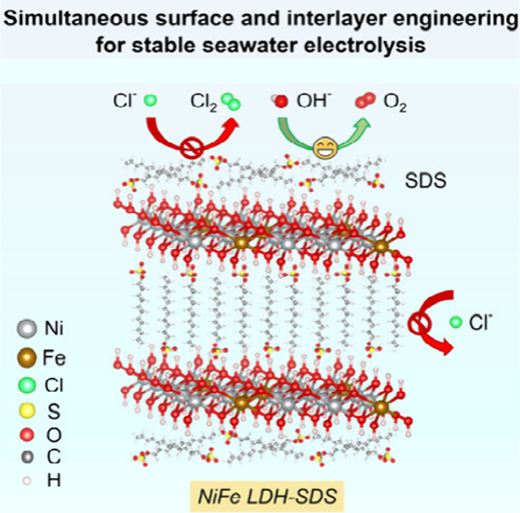
Ampere-level direct seawater electrolysis offers a sustainable approach for green hydrogen production, but its advancement is hindered by the competitive chloride evolution reaction (ClER) and catalyst corrosion at the anode. To overcome this limitation, we herein demonstrate a simultaneous surface and interlayer engineering of NiFe layered double hydroxide (LDH) anode by incorporating anionic surfactant (sodium dodecyl sulfate, SDS) through a facile anion exchange strategy. The dodecyl sulfate (DS) anion intercalation significantly expands the interlayer spacing and modulates the electronic structure of metal centers, thereby enhancing the intrinsic oxygen evolution reaction (OER) activity. Concurrently, the anionic groups anchored in the interlayer and adsorbed on the surface create a persistent electrostatic barrier that effectively repels Cl– ions. Consequently, NiFe LDH-SDS achieves 1.0 A cm–2 at low overpotentials of 311 mV and 353 mV in alkaline simulated and natural seawater, respectively, and delivers exceptional corrosion resistance and durability, operating stably for over 500 h in simulated and 380 h in natural seawater at 1.0 A cm–2, which far outperforms pristine NiFe LDH. More impressively, it sustains consistent performance for 500 h in overall seawater splitting at 1.0 A cm–2. This work offers a facile route to develop corrosion-resistant OER electrocatalysts for seawater splitting.
Simultaneous Surface and Interlayer Engineering of NiFe LDH via a Facile Anionic Surfactant Incorporation for Stable Ampere-Level Seawater Oxidation
Date : 2026-
Article type
Journal
Journal/Conference Name
The Journal of Physical Chemistry Letters
×

https://people.iut.ac.ir/en/daneshvari/content/1706436?view=qrcode